
The Role of Research in Design: From Insight to Execution
At its most fundamental level, research is the application of scientific thinking to inquiry. It is a disciplined process of observation, analysis, and validation that seeks to uncover truths—not just trends.
Research is the structured inquiry that transforms intuition into evidence. In design, it introduces logic, empathy, and context into what could otherwise be subjective decisions. It replaces guesswork with validation and moves teams from instinct to insight.
Without a discovery phase, designing is akin to building without adequate knowledge. Research shines light on user behaviors, environmental context, business goals, and usability barriers—making it not just a support system, but a strategic driver.


Why Research Matters in Design
Research transforms insights into action. It defines the real-world problems that need solving and equips teams to act intentionally rather than reactively. While creativity drives innovation, research provides the compass. It reframes challenges, revealing what matters to users and how brands can respond.
Designers often talk about empathy. Research makes it operational. Without findings, teams risk designing for themselves or for a mythical “average” user. With research, they begin to see people in their complexity—diverse needs, contexts, motivations, and challenges. This is how empathy becomes practical.
In different contexts:
-
In UX, research exposes obstacles to usability.
-
In branding, it surfaces the emotional perceptions that shape identity.
-
In content, it defines voice, tone, and resonance.
-
In development, it helps prioritize what gets built—and why.
Research doesn’t slow design down. It sharpens the focus.

Research as a Fundamental Principle of UX Design
User experience design begins with understanding—what people need, how they behave, where they struggle, and why they care. Research is the mechanism by which this understanding becomes actionable. It isn’t just a tool for UX—it’s the backbone of the discipline.
While aesthetics, usability, and interface architecture are visible outcomes of UX design, they are only meaningful when rooted in validated insights. Research uncovers friction points, identifies mental models, reveals environmental context, and distinguishes user intent from assumption.
In UX, it answers the most critical questions:
-
Who are we designing for?
-
What are their goals and constraints?
-
How does our solution fit into their world?
Without these answers, even beautifully executed experiences can fall flat. With them, teams design experiences that are intuitive, inclusive, and impactful.
In UX, research is not a phase. It’s a principle.
Whether conducted formally or informally, through generative studies or evaluative testing, research is what turns usability into a practice—not a guess. It’s how we move from assumptions about users to authentic experiences designed around them.

The Many Faces of Design Research
Research adapts to context. A fast-moving sprint may call for lean validation, while a full rebrand may require deep discovery. Effective teams mix methodologies to create a comprehensive view.
User Interviews and Observational Studies
The most powerful insights often come from real conversations. Talking to users reveals their goals, struggles, and behaviors in their own words. Observations—whether through usability tests, ethnographic shadowing, or video diaries—reveal discrepancies between what users say and what they do.

Surveys, Analytics, and Behavior Tracking
Quantitative data adds scale to qualitative depth. Tools like surveys, heatmaps, session replays, and clickstream analytics provide measurable feedback. These methods help test hypotheses, benchmark changes, and spot trends over time.

Competitive and Comparative Analysis
Understanding the external landscape gives research context. Analyzing competitors and analog solutions identifies design conventions, white space opportunities, and innovation gaps. It also informs usability baselines—what users already expect.
Internal and External Stakeholder Inclusion
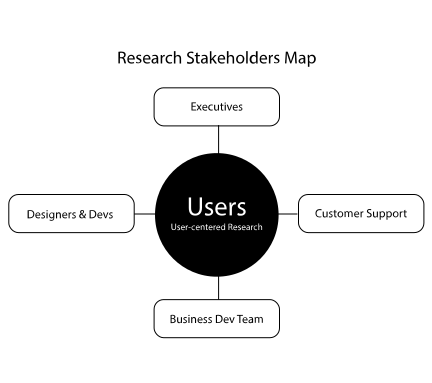
Good design balances user needs with organizational goals. Interviewing internal stakeholders—executives, product owners, customer support—reveals strategic intentions and operational constraints. This ensures that the design aligns with long-term vision and practical realities.
In any research process, users remain at the center, serving as the core connection point between business objectives, technical execution, and support functions—ensuring every decision is grounded in real human needs.
Research Is Not a Phase—It’s a Thread
Too often, research is treated as a one-time task to kick off a project. In reality, it’s an ongoing practice that supports discovery, testing, iteration, and refinement.
-
Early discovery surfaces themes and problem spaces.
-
Prototyping and testing validate direction.
-
Post-launch feedback reveals real-world impact.
-
Ongoing measurement drives optimization.
Design is never finished—and neither is research.

From Insights to Implementation
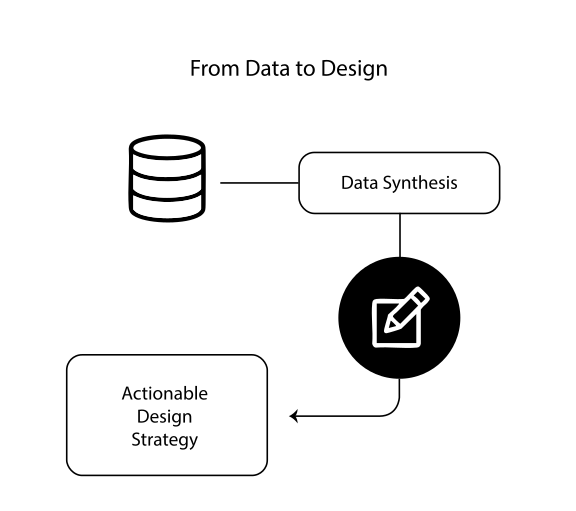
Research is not just about data collection. Its power lies in translation. Raw observations need to be translated into patterns. Quotes become themes. Metrics become signals. This is where research shifts from raw input to strategic action.
The outputs of good research aren’t just findings—they’re frameworks:
-
Personas
-
Journey maps
-
User flows
-
Content strategies
-
Technical priorities
These artifacts help cross-functional teams align on what to build and why.
The best research doesn’t just answer questions. It reframes them.
Making Research Participatory
Research should be a shared experience—not just a report passed along. When designers, developers, and strategists witness research firsthand, empathy deepens. Watching a user struggle with an interface or reading a quote from a dissatisfied customer has more impact than a secondhand summary.
Invite others to:
-
Observe interviews
-
Suggest research questions
-
Participate in synthesis workshops
And always treat users as collaborators, not test subjects. Privacy, transparency, and gratitude are essential to honoring the human part of human-centered design.
When teams participate in research, they stop designing for users—and start designing with them.
When Research Challenges Assumptions
Research doesn’t just confirm what we already believe. Its most valuable moments often come when it challenges deeply held assumptions.
A design team might assume a feature is essential—only to discover users find it confusing or unnecessary. Or they might believe a visual identity is memorable—when, in fact, it blends in with competitors.
These uncomfortable insights provoke growth. Research doesn’t validate egos. It validates experience.
Research as a Creative Catalyst
There’s a misconception that research is dry or clinical—that it restricts creativity. The opposite is true.
Research clarifies the problem space, which gives designers constraints—and constraints drive innovation. Real stories, lived experiences, and edge cases spark ideas that speculative brainstorming never could.
Research grounds inspiration in reality. It connects ideation with meaning. Research fuels creativity, not with guesses—but with context.

Common Pitfalls in Design Research
Even strong teams fall into research traps:
-
Confirmation bias: Asking questions to prove a point.
-
Overgeneralizing: Drawing conclusions from too few users.
-
Siloing findings: Letting reports gather dust without sharing insights.
Good research requires critical thinking. Interpret results with nuance, and look for outliers as much as consensus.
Research at Scale
Research must be flexible. While large companies may fund dedicated labs, smaller teams can still generate insight.
Start lean:
-
Interview a handful of users
-
Analyze support tickets
-
Review analytics patterns
-
Run short usability tests
Build a habit of inquiry. Document what you learn. Share it widely. Small insights often spark big changes. You don’t need a lab. You need curiosity.
The Future of Research
Emerging tools—AI-driven analysis, real-time behavior modeling, biometric feedback—are expanding the capabilities of research. But technology is just an enabler.
The core question remains: What do people need?
The best insights will still come from the intersection of smart tools and empathetic thinking. Research will become faster, deeper, and more integrated—but never fully automated. AI can surface patterns. Only humans can interpret meaning.
Designing with Purpose
Research is the foundation of intentional design. It moves teams from assumption to understanding, from noise to clarity. It ensures that what we create is not just functional—but resonant.
In a crowded digital landscape, research is how we tune into what matters. It’s how we design with meaning—and with people in mind. Good design starts with listening. Great design never stops.
Our published articles are dedicated to the design and the language of design. VERSIONS®, focuses on elaborating and consolidating information about design as a discipline in various forms. With historical theories, modern tools and available data — we study, analyze, examine and iterate on visual communication language, with a goal to document and contribute to industry advancements and individual innovation. With the available information, you can conclude practical sequences of action that may inspire you to practice design disciplines in current digital and print ecosystems with version-focused methodologies that promote iterative innovations.
Related Articles –
-

Click Maps and Scroll Maps: Decoding the Invisible User Journey
-

Types of UX Research: A Complete Guide to Methods, Frameworks, and When to Use Them
-

Multivariate Testing: Optimizing UI Through Combinational Insight
-

Comprehensive Guide to Crafting Effective Usability Testing Questions for Websites
-

Making Sense of Structure: How Card Sorting Shapes Intuitive UX Design
-

Human-Centered Design: Creating Solutions That Matter
-
Empathy or No Empathy: The Dual Roles in UX Design
-

How to Best Perform Data-Driven UX Design
-

WordPress: Revealing the Truth About WP Capabilities for Large-Scale Web Projects
-

Types of UX Research: A Field Guide for Real-World Product Teams